Saturday, June 9, 2012

Thanks for a great quarter!

Well, I've just submitted my final grades, and while I have an inordinate amount of work to get done before leaving for the airport at 5am tomorrow, I wanted to take a moment to say how impressed I was with the quality of the final projects I received.  

There were a lot of different approaches taken — some very quote and character-heavy, others more abstractly connected to the material but still very much in line with the spirit and tone of Vonnegut's work — and I can't really say that anyone phoned it in.  People from whom I expected great work turned in great work, but those of you who've been silently hanging out in the back of the room all term also dug down deep and produced some solid final pieces.  There are some very talented writers in the class who produced imaginative pieces (sometimes hilarious, sometimes emotional, sometimes outrageous) that were all fun to read, but also provided effective commentaries on both Vonnegut's life and writing, as well as the world we all find ourselves living in.  Also, some of you seem to have really relished the opportunity to write freely (almost expressionistically) about those perennial favorites: sex, drugs and murder . . .

Anyway, when I came up with this idea for the final, it was a bit of an inspired moment, but I wasn't sure what the end results were going to be.  Now that I've read nearly forty papers, I couldn't be happier that I decided to follow that impulsive idea, because you really rose to the challenge and produced spectacular work.

Congratulations to all of you who're graduating today, and to my freshmen who I met on their first day at UC for surviving year one!  If you have a moment, please fill out the Facebook surveys about your favorite and least favorite books from the reading list (or just leave a comment here).  Thanks again and have a great summer!

Tuesday, May 29, 2012

Wrapping Up / A D.I.Y. Vonnegut Semester Plan

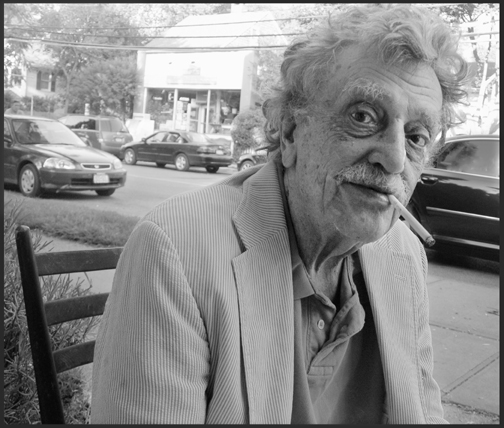
Kurt Vonnegut in August 2006, less than a year before his death.

Here's a collection of obituaries and tributes to Vonnegut filed after his death in April 2007.  You might want to read over a few prior to Thursday's class, when we'll try to sum up our work this quarter and find some basic lessons and ideas to take away from the eight novels we've read:

Finally, here's one of Vonnegut's last televised interviews, with PBS' NOW in 2005:


So it goes, and you go as well, from the confines of this class on to (I dare to hope) a life-long relationship with literature.  I heard someone complaining before class started that she had nothing to read now that the school year was over, and believe me, I can sympathize.  The benefit to you having just spent the last ten weeks so thoroughly immersing yourself in Vonnegut's life and writing, however, is that you're primed to keep reading through his collected works (well, presuming that you actually liked the course), so here are my suggestions.

I'm starting with the idea of what I'd add to the book list should I have the opportunity to teach this class again under semesters.  In rough formulaic fashion, here's what I'd plan:


I will admit to being somewhat torn about the three additional books listed here.  Breakfast of Champions is not Vonnegut's finest hour, but it's probably the most useful book to add, since it makes connections between and fills out backstories of characters and places that are central to both Deadeye Dick and Galápagos and is largely focused on Kilgore Trout.  Mother Night provides a lot of backstory for Howard Campbell, who we meet in Slaughterhouse-Five, and also helps bridge the eleven-year gap between Player Piano and Cat's Cradle, but I'm personally not as enamored of Vonnegut's earlier style where he's feeling a little more bound by the rules of contemporary fiction.  Bluebeard is probably the best of the three books, but aside from a tiny connection to Deadeye Dick, it exists in its own world — still, not a bad choice if you're interested in learning more about Vonnegut's feelings on the purpose and usefulness of art, or to get more insights into his second marriage.  The Sirens of Titans (dedicated to Uncle Alex) isn't a bad choice either, particularly if you're into early sci-fi Vonnegut.  The only two books I'd steer clear of entirely (or at least until you've read the rest) are Slapstick (which at the very least has some worthwhile remembrances of Vonnegut's sister Allie and Uncle Alex) and Hocus Pocus (which doesn't).

What about the short story collections?  Well, I did consider using Welcome to the Monkey House for this class, but my feeling was that a) it can be difficult for students to transition from the macro-scale of novels to the micro-scale of stories, and b) those stories are conceived more for popular audiences, so they're not quite as substantive as Vonnegut's other writing.  If you're interested in some short attention span delights, however, there are four volumes altogether, including Bagombo Snuff Box and the two posthumous editions published in recent years.  What might be a better place to go are the volumes of essays, speeches, interviews, etc.: Wampeters, Foma and GranfalloonsPalm Sunday; Fates Worse than Death; A Man Without a Country.

And, after spending the last ten weeks telling you not to read it, I think you're prepared to bear the full brunt of Vonnegut's personality as revealed in Charles J. Shields wonderful biography, And So It Goes: Kurt Vonnegut — A Life.  It's a fantastically thorough document of the author's life and times, and provides all sorts of useful background on Vonnegut, his family, his writing process and much more.  Not unlike many of the novels we've read, it ultimately feels incomplete and overwhelmingly sad in the end, but that's more the fault of Vonnegut's dog than Shields.

Interested in some postmodern fiction outside of Vonnegut?  Two authors whose names came up in class the other day, and who I can wholeheartedly recommend are Donald Barthelme and Richard Brautigan.

Barthelme's one of my very favorite writers, not to mention one of the most influential prose stylists in 20th century literature.  If you'd like to dip your toe in the water before buying anything, you can read a number of his best-known stories here.  Should be be eager for more, I'd suggest starting with the collections Sixty Stories and/or Forty Stories, plus the novels Snow White and The Dead Father (though start with the stories and work up to the novels).  When I first started reading Barthelme, the posthumous volumes containing the rest of his stories hadn't yet been published, so I had to track down the individual collections (all of which are pretty ubiquitous and cheap), of which my favorites are City Life, Amateurs and Unspeakable Practices, Unnatural Acts.

For Brautigan, most of his work is now available in omnibus editions reprinting three books under one cover.  His best known novel is Trout Fishing in America, and some of his other books published in those collections that I'm quite fond of include The Abortion, A Confederate General from Big Sur and Revenge of the Lawn, along with the poetry collections Rommel Drives on Deep Into Egypt and The Pill Versus the Springhill Mine Disaster.  Perhaps my favorite Brautigan book altogether, though one you'll have to hunt down on the used market, is The Tokyo-Montana Express.  You can find more info on him here.

Those of you who haven't had the Beat Generation class with me might want to check out Jack Kerouac (start with On the Road, then try The Dharma Bums, Desolation Angels, Big Sur) or William S. Burroughs (start with Junkie or Naked Lunch then try Exterminator!, Interzone or the Nova Trilogy novels).  Beyond that (but hey, you're running out of summer at this point, right?) here are a few other favorites I've taught (or would like to teach) in classes on postmodern American fiction:

  • Susan Sontag — primarily an essayist/theorist, but her short story collection, I, etcetera is great
  • Don Delillo — White Noise and Mao II are classics of the era
  • Thomas Pynchon — The Crying of Lot 49 is a good introduction to his work
  • Robert Coover — I've had great pleasure teaching The Universal Baseball Association, Inc., J. Henry Waugh, Prop. and Pricksongs and Descants
  • Ron Loewinsohn — Magnetic Field(s) is a true sleeper — a marvelous book no one seems to know about
  • E.L. Doctorow — Ragtime is where most folks start
Of course, my true love and focus over the past five years or so has been poetry.  If you're looking for reading suggestions in that genre, just drop me a line.

Tuesday, May 22, 2012

Sunday, May 20, 2012

Weeks 9 and 10 "Timequake" (1997)


Kilgore Trout to the rescue!  Seriously!  You didn't think that Kurt Vonnegut would sign off from novel writing without giving his alter ego and greatest creation one last moment in the limelight, right?

Of course, Timequake almost didn't come to pass.  In his prologue, Vonnegut compares his struggle to bring this novel into being to the existential struggle of Santiago against his prize catch in Ernest Hemingway's The Old Man and the Sea, and explains how the unfinished manuscript that he calls Timequake One — "which did not work, which had no point, which had never wanted to be written in the first place" — was gutted and recycled to create our current text, Timequake Two.  He finished the manuscript, "a stew made from [Timequake One's] best parts mixed with thoughts and remembrances during the past seven months," one day after his seventy-fourth birthday.


Part of what makes this novel so fascinating — and a key reason why I chose this for the class instead of Mother Night, Breakfast of Champions or Bluebeard — is its unintentional and tragic, yet unavoidable, historical context, thanks to its central plot device.  Writing in 1997 about a timequake that would hurtle his characters from February 13, 2001 to February 17, 1991, Vonnegut had no idea that the September 11th attacks would happen and yet, we can't read Timequake without being indelibly haunted by that knowledge, and I think that, for anyone who reads this book from September 12, 2001 forward (as I first did in the spring of 2002), the book's resonance is greatly amplified — by our shared desire to "turn back the clock" to the simpler times before that day, and also in our sympathies for the book's characters, who, having survived the timequake will have to face yet another life-altering challenge a little over half a year later.


In a 1998 interview, Marylynn Uricchio asked whether Timequake would really be Vonnegut's final novel:
Q. Did you say Timequake was your last book so you couldn't change your mind?
A. I'm quite old. I'll be 76 in a few days. Some of this is an actuarial matter. I'm writing short stuff, I'm writing an op ed piece today about the hurricane in South America, but that's all I'm doing now. No more novels. No more books need be written.
He proved true to his word — while Vonnegut would publish several other books in his lifetime, including a slim volume of radio monologues, (God Bless You, Dr. Kevorkian, 1999), a collection of his early unpublished stories (Bagombo Snuff Box, 1999) and a book of essays (A Man Without a Country, 2005) he never did publish another novel, even if he often hinted that he was at work on one entitled, If God Were Alive Today. Several posthumous books have appeared as well, namely three odds-and-sods collections of unpublished stories, essays, speeches, etc.: Armageddon in Retrospect, Look at the Birdie and While Mortals Sleep.

Later in the same interview, in response to Uricchio's asking, "When your work is talked about 100 years from now, what do you want people to say?," Vonnegut offers an elegant summation of his life's work:
I doubt it will be talked about 100 years from now. I don't know. All I really wanted to do was give people the relief of laughing. Humor can be a relief, like an aspirin tablet. I'd be certainly pleased if 100 years from now people are still laughing.
He has another 86 years to go, but 14 years since that statement — and five since his death — I'd say that his reputation is (and will be) secure for a very long time.

Here's our reading schedule for Timequake:
  • Thursday, May 24:  prologue - ch. 25
  • Tuesday, May 29:  ch. 26 - epilogue

And here are a few supplemental reading links:
  • "Vonnegut Stew," Valerie Sayers' New York Times review of the novel: [link]
  • "Kurt Vonnegut Says He's Retiring (We'll See)," Paul D. Colford's Los Angeles Times article on Timequake and Vonnegut's career plans after its publication: [link]
  • "Breakfast with Kurt Vonnegut," Uricchio's interview from The Pittsburgh Post-Gazette: [link]

Tuesday, May 15, 2012

Deadeye Dick — Final Observations

Deadeye:  [waking up from mid-class nap] Is it 1:45 yet?

Dick:  Nope . . . twenty minutes to go.

Deadeye:  Hey, what'd you get on the last quiz?

Dick:  Don't ask.

Deadeye:  Yeah, I got a 0.5, too.  How was I supposed to know that there wasn't an actual bird in Jailbird?

Dick:  I know!  Ugh, I'm sick of this class.  Why doesn't the teacher ever ask what I think about the book?  I want a chance to share my thoughts, fears and opinions in regards to contemporary literature.

Deadeye:  And why aren't there, like, more opportunities to earn a good grade?  What if there was a place on the blog where we could — optionally, mind you — say one last thing about the book that we didn't have a chance to say in class?

Dick:  That would be great, but this guy just doesn't care about his students!  Lucky for him, I'm not planning on showing up on the day we do evaluations.  Or, like, at all for the next two weeks!

Deadeye:  Hey, were we supposed to sign up for a presentation or something?

[ scene ]

Monday, May 14, 2012

Weeks 8 and 9: "Galápagos" (1985)


Over the course of our last few readings, we've seen a very different Vonnegut — one who's coming to terms with both the process of aging and his own shifting role in American arts and letters, and responding in kind with a strong pair of novels (Jailbird and Deadeye Dick) that are humanistic, character-driven affairs that stay largely within the realm of conventional (though still wild) reality.  This pattern will continue in Bluebeard, the last of four books marking a late high-point in Vonnegut's career (sandwiched between two of his worst offerings: Slapstick and Hocus Pocus), but in Galápagos, the author is more than happy to cast off the fetters of everyday existence and explore a fantastic, science-fiction future.

Nonetheless, Galápagos is very much a novel of its time: the worldwide financial woes that set the stage for the book's narrative speak to real-life stagnation in the early and mid-80s and it's no stretch to read the bacterial disease that makes all women but those on Santa Rosalia infertile as Vonnegut's attempt to address the AIDS crisis.  The Galápagos islands, likewise, serve not only as a setting for the novel but as a symbolic tie to Charles Darwin, who formulated his theory of evolution after investigating the novel ways in which the species native to the islands had developed in isolation.  In Jailbird, Vonnegut ruminates on the nature of the island and its occupants while describing scene at the Hotel Royalton's Coffee Shop on Walter's fateful first full day of freedom in NYC:
I thought to myself, "My goodness — these waitresses and cooks are as unjudgmental as the birds and lizards on the Galapagos Islands, off Ecuador."  I was able to make the comparison because I had read about those peaceful islands in prison, in a National Geographic loaned to me by the former lieutenant governor of Wyoming.  The creatures there had had no enemies, natural or unnatural, for thousands of years.  The idea of anybody's wanting to hurt them was inconceivable to them.
So a person coming ashore there could walk right up to an animal and unscrew its head, if he wanted to.  The animal would have no plan for such an occasion.  And all the other animals would simply stand around and watch, unable to draw any lessons for themselves from what was going on.  A person could unscrew the head of every animal on an island if that was his idea of business or fun (123-124 in my first edition hardcover, 174-175 in your paperbacks).


At the same time, while forces beyond human control do their part to shape the novel, it's worth noting that Vonnegut also finds fault within human action and intention — big brains and big ideas cause big problems.  While the novel's characters undergo physical transformations as they evolve, their brains change as well, getting smaller, and as far as Vonnegut is concerned (cf. this somewhat bombastic Los Angeles Times article), this is all for the best:
The big trouble, in Kurt Vonnegut's view, is our big brains. 
"Our brains are much too large," Vonnegut said. "We are much too busy. Our brains have proved to be terribly destructive." 
Big brains, Vonnegut said, invent nuclear weapons. Big brains terrify the planet into worrying about when those weapons will be used. Big brains are restless. Big brains demand constant amusement. 
"Our brains are so terrifically oversized, we have to keep inventing things to want, to buy," Vonnegut said with a shudder. "If you think of the 8 million people of greater New York charging out of their houses every day in order to monitor the planet, it is a terrifyingly destructive force. [...] 
"Among other things," he said of this giant computer lodged between humanity's collective ears, "it is capable of creating the Third Reich of Germany, which in fact so demoralized the world that I don't think we'll ever recover." 
The brain: "I think stupidity may save us," Vonnegut said. "I think we are too damned smart."
Finally, take note that the events of the novel take place in 1986, just one year after its completion, and the proximity is intentional on Vonnegut's part — if we don't wise up, he reasons, such fantastic events are not at all out of the realm of possibilities for the human race.


Here's our reading schedule for Galápagos:
  • Thursday, May 17:  book 1, ch. 1 - 24
  • Tuesday, May 22:  book 1, ch. 25 - book 2, ch. 14

And here are a few supplemental links:
  • "How Humans Got Flippers and Beaks," The New York Times' review of Galápagos: [link]
  • "Vonnegut Explores the Big Brain Theory," Los Angeles Times' review of the novel: [link]
  • a second LAT review of the book: [link]
  • an interview with Hank Nuwer that's largely concerned with Galápagos: [link]
  • an NPR essay by Ron Currie, Jr., who names Galápagos one of his "Three Books to Help You Enjoy the Apocalypse": [link]
  • "Evolutionary Mythology in the Writings of Kurt Vonnegut Jr.," Gilbert McInnis' 2005 essay, which originally appeared in Critique: Studies in Contemporary Fiction: [link]

Tuesday, May 8, 2012

Jailbird — Final Observations


Blah, blah, blah . . . either you know the drill and will respond in a timely fashion or you're not going to bother at all and when you stare at the great big F on your grade report you'll look to the heavens and beg: "Why?!?!?  If only someone told me that I was supposed to be making final observations posts!  If only there were more grading opportunities!!  If only I had bothered to read the books!!!"